
So, you’re thinking about leveling up your project management career, but you’re stuck deciding between the PMP certification and the CAPM certification . Maybe you’ve heard coworkers toss around terms like “PMI Talent Triangle” or “predictive project management approaches” and wondered, “Which of these certifications actually matters for someone like me?”
Let’s break it down. Whether you’re an entry-level project coordinator eyeing a promotion or a seasoned pro aiming to lead complex projects and direct project teams , choosing between the CAPM and PMP credentials is a big decision. Both are backed by the Project Management Institute (PMI) , but they serve very different audiences.
In this guide, we’ll compare everything from pmp certification requirements to salary for CAPM holders , so you can decide which path aligns with your career goals . Spoiler: It’s not just about the letters after your name—it’s about where you are today and where you want to be tomorrow.
PMP vs CAPM: What’s the Difference?

Let’s start with the basics. The Project Management Professional (PMP) and Certified Associate in Project Management (CAPM) are both globally recognized certifications, but they cater to different experience levels.
Who Should Get CAPM?
- CAPM is ideal if you’re new to the world of project management .
- Requires a high school diploma and 23 hours of project management education (like a course from a PMI authorized training partner ).
- No formal experience needed—perfect if you need to enter project management without prior leadership roles.
- Focuses on project management principles and knowledge of PMI’s Project Management Body of Knowledge (PMBOK) .
Who Should Go for PMP?
- Aimed at project managers with at least three years of experience (or 36 months if you have a bachelor’s degree).
- Requires 35 hours of project management education and proof of experience leading projects .
- Validates expertise in managing complex projects and direct project teams .
- Employers often require PMP certification when hiring for senior roles.
Read More https://prepare4test.com/ccna-exam-fees/
Still fuzzy? Here’s a quick comparison table:
| Criteria | CAPM | PMP |
|---|---|---|
| Experience Required | None | 3+ years (36 months) leading projects |
| Education Prerequisite | 23 hours of project management education | 35 hours of project management education |
| Exam Details | 150 questions, 3 hours | 180 questions, 3 hours 50 minutes |
| Focus | Foundational theory | Advanced leadership, agile hybrid methods |
| Cost (Non-PMI Members) | $300 | $595 |
| Ideal For | Entry-level roles | Senior PM roles, positions in project management leadership |
(Source: PMI Certification Overview )
Exam Face-Off: CAPM vs PMP Exams
CAPM Exam: A Foot in the Door
The CAPM exam tests your grasp of project management knowledge from the PMBOK Guide. It’s less rigorous than the PMP exam , with questions focused on terminology, processes, and basic methodologies. Think of it as a crash course in PMI’s framework—ideal if you’re still learning the basics of project management .
But don’t underestimate it: You’ll need to study hard. The exam covers 13 chapters of the PMBOK and includes questions that represent predictive project management approaches (think Waterfall).
PMP Exam: Proving Your Leadership Chops
The PMP exam is notoriously tough. It’s designed to test how you handle real-world scenarios, from stakeholder conflicts to hybrid agile workflows. According to the PMP Examination Content Outline , 50% of the exam focuses on predictive project management , 42% on agile, and 8% on business analysis.
You’ll need to demonstrate not just knowledge but judgment. For example:
- “Your project is behind schedule. Do you fast-track, crash, or re-baseline?”
- “How do you prioritize risks when budget and scope are competing?”
Passing requires deep familiarity with the PMI Talent Triangle (Technical, Leadership, Strategic skills) and hands-on experience.
Career Impact: Salaries, Roles, and Credibility
CAPM: Entry-Level Certification, Entry-Level Pay
CAPM holders typically land roles like Project Coordinator or Junior PM. According to PMI’s Earning Power Salary Survey , the average salary for CAPM holders in the U.S. is around $74,000. That’s solid for starters but pales next to the PMP certification’s $118,000 average.
The CAPM certification demonstrates foundational knowledge, making it a smart move if you’re competing for candidates for positions in project management without experience. However, many employers still require PMP certification for leadership roles.
PMP: The Gold Standard for Career Growth
PMP professionals dominate senior roles like Program Manager or Director of PMO. The certification is often non-negotiable for employers hiring project managers , especially in industries like tech, construction, and healthcare.
Why? PMP holders are proven to:
- Deliver projects 2.5x more successfully (PMI).
- Earn 20% higher salary than those without certification.
Plus, the PMP certification exam is a badge of credibility. It signals you’ve survived a rigorous exam and can handle predictive and agile project management challenges.
Read Also https://prepare4test.com/product-category/pmi/pmi-pmp/
The Cost of Credibility: CAPM vs PMP Certification Exams
Let’s talk money. The CAPM exam costs $300 for non-PMI members (vs. $225 for members). The PMP certification exam is steeper at $575 for non-members ($405 for members). But here’s the kicker: PMP’s ROI is unmatched.
Pro Tip: If you plan to take the PMP eventually, consider a PMI membership ($129/year). It slashes exam fees and gives you free access to the PMBOK Guide.
Maintenance: PDUs, Retakes, and Long-Term Value
Both certifications require upkeep:
- CAPM: Retake the exam every five years (no PDUs needed).
- PMP: Earn 60 Professional Development Units (PDUs) every three years through courses, webinars, or mentoring.
While CAPM is simpler to maintain, PMP’s renewal process ensures you stay updated on trends like agile and AI in project management.
People Also Read https://prepare4test.com/product-category/pmi/certified-associate-in-project-management/
CAPM vs PMP: Which Certification is Right for You?
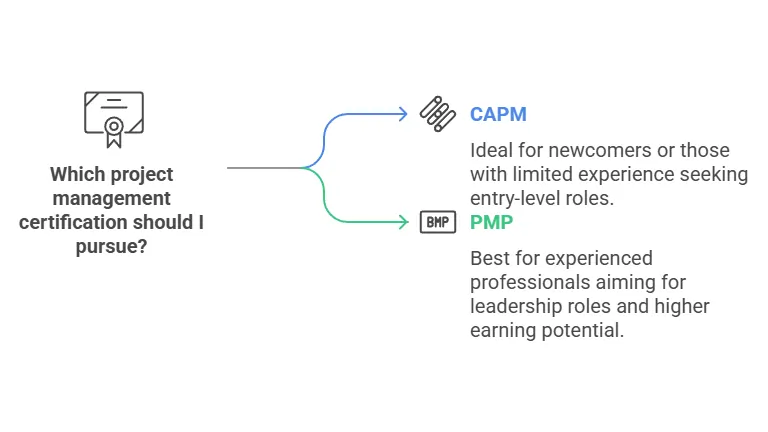
Start With CAPM If…
- You’re new to the field and need a recognized certification to break in.
- You want to test the waters before committing to PMP’s three years of experience requirement.
- Your career goals include junior roles or transitioning from another industry.
Go Straight to PMP If…
- You’ve already logged 36 months leading projects.
- You’re aiming for leadership roles where employers require PMP certification when hiring .
- You want maximum earning power and credibility.
Still torn? Ask yourself:
- “Do I have significant project management experience ?”
- “Are my target jobs listing PMP certification as a requirement?”
Related Post https://prepare4test.com/exam/capm-dumps/
Final Verdict
The CAPM and PMP certifications aren’t competitors—they’re stepping stones. The CAPM gives you the vocabulary and theory to start your journey, while the PMP propels you into leadership.
If you’re eyeing a project management career but lack experience, getting a CAPM is a savvy first move. But if you’re ready to lead complex projects and direct project teams , the PMP’s higher salary and prestige are worth the grind.
Either way, both certifications prove you’re serious about mastering the marks of the project management world. Now, go crush those exams!
(Need more help? Check out PMI’s PMP Handbook or Coursera’s CAPM Prep Course .)
You’ve got questions? Drop them below! 👇 Let’s chat about your career in project management goals.
FAQs
What are the main differences between PMP and CAPM ?
The primary differences between CAPM and PMP certifications lie in their requirements and target audiences. The CAPM® certification is designed for individuals who are new to project management and may not have extensive experience in the field. It requires a secondary degree and either 1,500 hours of project experience or 23 hours of project management education. On the other hand, the PMP certification is aimed at experienced project managers and requires a four-year degree, 4,500 hours of leading and directing projects, and 35 hours of project management education. The PMP exam also covers a broader range of topics, including leadership and strategic business management.
Who should consider obtaining a CAPM® certification ?
The CAPM® certification is ideal for individuals who are just starting their careers in project management or those who want to enhance their credentials to gain entry-level positions. It is suitable for recent graduates, career changers, or anyone looking to gain a foundational understanding of project management principles without extensive project management experience. The CAPM serves as an excellent introduction to the field and can be a stepping stone to the PMP certification in the future.
Why is the PMP certification considered more valuable than the CAPM ?
The PMP certification is often regarded as more valuable because it is recognized globally as a gold standard in project management certification . It signifies a high level of competence and a strong commitment to the profession. The PMP requires significant experience and knowledge, which is why it is preferred by employers when hiring project managers . The PMP exam also tests a candidate’s ability to apply project management principles in real-world scenarios, which is crucial for advanced project roles.
Can I pursue a PMP certification without first obtaining a CAPM® certification ?
Yes, you can pursue a PMP certification without first obtaining a CAPM® certification . The CAPM is not a prerequisite for the PMP . However, meeting the project management education requirement and having the necessary project management experience are essential for eligibility to take the PMP exam.
