
In a world where cyber threats evolve faster than ever, staying ahead requires more than just knowledge and skills —it demands validation. Enter the Palo Alto Networks Certified Network Security Administrator (PCNSA) certification, a credential designed to validate expertise in managing Palo Alto Networks Next-Generation Firewalls (NGFWs) . Whether you’re a seasoned security professional or an IT enthusiast looking to protect networks , this certification could be your ticket to career growth and technical mastery.
But here’s the twist: PCNSA is retiring on January 31, 2025 . While this might sound alarming, existing certifications remain valid for two years , and Palo Alto’s new role-based certifications are stepping into the spotlight. Let’s unpack what PCNSA offers, why it’s still relevant in 2025, and how you can leverage it to secure your future.
What is the PCNSA Certification?
The PCNSA ( Palo Alto Networks Certified Network Security Administrator ) is a foundational certification that validates the knowledge and skills required to configure, manage, and troubleshoot Palo Alto Networks firewalls . It’s tailored for administrators responsible for deploying and managing Palo Alto Networks NGFWs in real-world environments.

Key Focus Areas
- Firewall Management : Configuring PAN-OS networking settings, security policies, and network traffic rules.
- Threat Prevention : Using App-ID , WildFire , and Content-ID to block advanced cyber threats .
- Operational Best Practices : Ensuring device configuration aligns with cutting-edge security standards.
PCNSA vs. New Role-Based Certifications: What’s Changing?
Palo Alto Networks is shifting to a role-based certification framework, retiring legacy exams like PCNSA to streamline their portfolio . Here’s how the old and new stack up:
| Aspect | PCNSA (Legacy) | Next-Gen Firewall Engineer (New) |
|---|---|---|
| Focus | Foundational NGFW administration | Advanced deployment, automation, and SASE integration |
| Exam Content | Basic firewall policies, threat prevention | In-depth PAN-OS automation, Zero Trust, API integration |
| Validity | Expires in 2027 (if certified pre-2025) | 2 years, with recertification options |
| Target Audience | Network admins, entry-level engineers | Engineers, architects, support engineers |
While PCNSA is phasing out, it remains a valuable credential for those seeking comprehensive knowledge of Palo Alto Networks firewalls . Plus, it’s a stepping stone to advanced certs like PCNSE (Palo Alto Networks Certified Network Security Engineer).
Why Pursue PCNSA in 2025?
1. Validate Foundational Expertise
PCNSA certification validates your ability to:
- Configure and deploy NGFWs to protect networks .
- Implement security policies and threat prevention mechanisms.
- Use Panorama for centralized management and operations .
2. Boost Career Opportunities
- Salary Bump : PCNSA-certified professionals earn $95,000–$120,000 annually, with roles like Network Security Administrator and Security Engineer in high demand .
- Industry Recognition : Employers trust Palo Alto’s certifications for their alignment with operational best practices .
3. Seamless Transition to New Certs
Retiring PCNSA doesn’t mean your skills are obsolete. The new Next-Generation Firewall Engineer certification builds on PCNSA’s foundational concepts, emphasizing automation and SASE (Secure Access Service Edge) integration .
The PCNSA Exam: What You Need to Know
Exam Structure
- Format : 60–70 multiple-choice questions.
- Duration : 80 minutes (plus 10 minutes for NDA/survey).
- Cost : $155 USD .
- Passing Score : ~70–80% (varies by exam version).
Core Domains
- Device Management & Services (22%): HA configurations, software updates.
- Security Policies & NAT (28%): Rule creation, address objects.
- App-ID & Threat Prevention (30%): SSL decryption, malware analysis.
- Monitoring & Troubleshooting (20%): Log analysis, traffic diagnostics.
How to Prepare for the PCNSA Exam
1. Enroll in Official Training
Palo Alto’s Firewall Essentials (EDU-210) course covers PAN-OS fundamentals and firewall management . Pair it with practice tests from platforms like Udemy or ITExams to gauge readiness .
2. Hands-On Labs
- Use virtual lab environments to simulate deploying and operating Palo firewalls.
- Practice creating security policies and configuring GlobalProtect VPNs .
3. Leverage Study Communities
Join forums like the Palo Alto LIVEcommunity to discuss real-world scenarios and troubleshoot common issues .
Implications of PCNSA Retirement
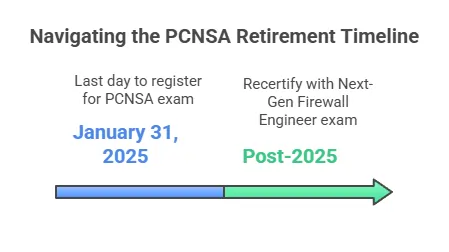
- Act Fast : If you’re mid-preparation, register for an exam before January 31, 2025 .
- Plan for Recertification : Existing PCNSA holders can recertify by passing the new Next-Gen Firewall Engineer exam post-2025.
- Focus on New Skills : Embrace automation and cloud security trends highlighted in Palo Alto’s updated portfolio .
Conclusion: Is PCNSA Still Worth It?
While the PCNSA certification is sunsetting, its value persists for those seeking foundational expertise in Palo Alto Networks firewalls . It’s a proven way to validate your skills, boost your resume, and transition into advanced roles. Just remember: the cybersecurity landscape never sleeps. Stay curious, keep learning, and prepare to pivot as Palo Alto’s cutting-edge certifications evolve.
Ready to start? Register for an exam today and join the ranks of security professionals who protect networks with confidence.
References & Resources
- Palo Alto Networks Certification Program
- PCNSA Practice Tests (Udemy)
- Pearson VUE Registration Portal
- PCNSA Salary Insights
Stay secure, stay certified! 🔒
FAQs
What is the PCNSA certification?
The PCNSA (Palo Alto Networks Certified Network Security Administrator) is a certification designed to validate a candidate’s ability to administer Palo Alto Networks’ products and solutions . It demonstrates the knowledge necessary to effectively deploy and manage Palo Alto Networks NGFW (Next-Generation Firewall) in a production environment. This cert is ideal for those looking to maintain the highest level of security within their organization.
Who should pursue the PCNSA certification?
The PCNSA is targeted towards IT professionals, network security generalists , and individuals seeking to gain an understanding of networking and security principles. Whether you are a system administrator, network engineer, or security analyst, this cert can help you enhance your skills in using Palo Alto Networks NGFW to protect networks . It is also beneficial for those looking to advance their careers in the field of digital security.
What topics are covered in the PCNSA exam?
The PCNSA certification exams cover a range of topics including the configuration and management of Palo Alto Networks NGFW , security and networking fundamentals, policies and rules configuration, and firewalls to protect networks . It ensures that a candidate has an in-depth knowledge of how to secure networks using Palo Alto’s products and solutions .
How can I prepare for the PCNSA exam?
To effectively prep for the PCNSA exam, it is recommended to take advantage of official study materials provided by Top Palo Alto Networks . These resources include study guides, online courses, and practice exams. Additionally, gaining hands-on experience with Palo Alto Networks NGFW and engaging with community forums can greatly enhance your understanding of networking concepts and practical application.

